

How SimpleDifferent service is different
The creation and development of SimpleDifferent is the result of a dual challenge, to merge the ergonomic aspect of web design with the human potential.
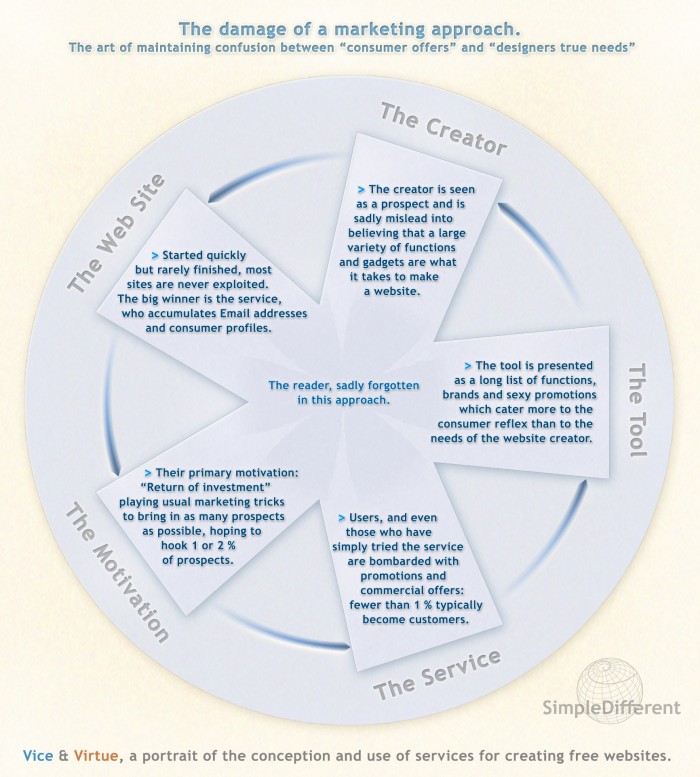
Our systematic review of the major website creation tools currently on the market shows remarkable similarity in the way that they approach the Internet. Users are not treated as future web designers but only as prospects; prospective customers to be caught at any cost.
All of these services focus on a quantitative approach: giving users a multitude of functions, widgets, modules, service partners, numbers of pages offered, sites, disk space, bandwidth… This is the downfall of a market dominated by a marketing approach that is not adapted in this case to user satisfaction. They are forced into a price war, with misleading promotions and lack of transparency in what one really needs to make a website.
The offer of all these superfluous functions, telling users for example that metadata is the only thing needed for search engine optimization, constantly bombarding users with promotions and meaningless figures... all acts to clutter the mind of the site creator and causes him to forget the essential: The reader.
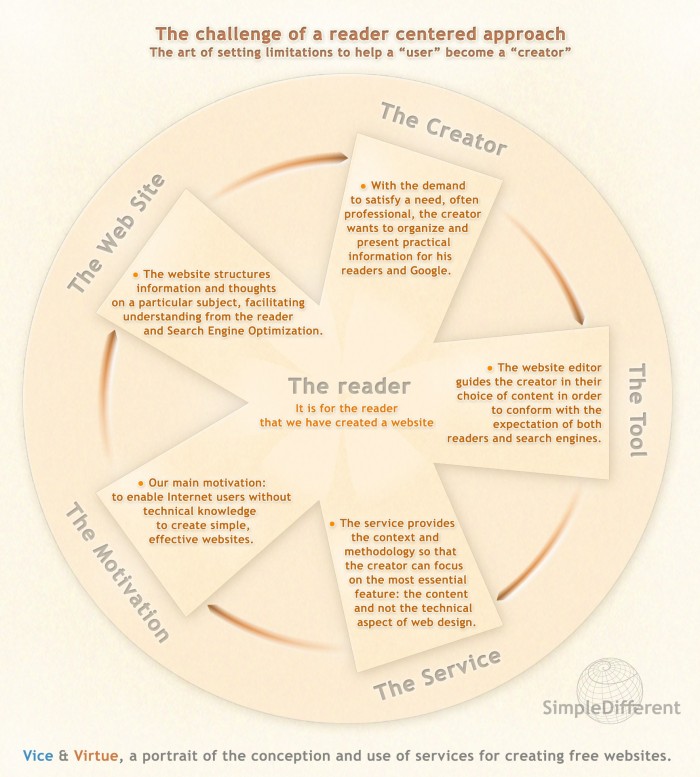
SimpleDifferent was created for people who recognize their own need for a website. The service is not meant to pander to the instinctive drives of consumers, with offers of more or bigger services. We choose not to fall into the traps of marketing our service this way, instead, we focus on the users potential to succeed in reaching his reader.
The simplicity of the SimpleDifferent interface stresses that the designer understands and provides what a reader is expecting to find.
An ergonomic approach is not limited to ease of use. It also takes into account the progressive manner in which SiteMasters discover the resources that are available.
The purposeful limitations of SimpleDifferent are in place to allow users to learn the service and express their own creativity. While at first glance SimpleDifferent may seem too simple, the functions become richer as users explore and learn the service. The simplicity allows users to learn to walk before they are expected to run.